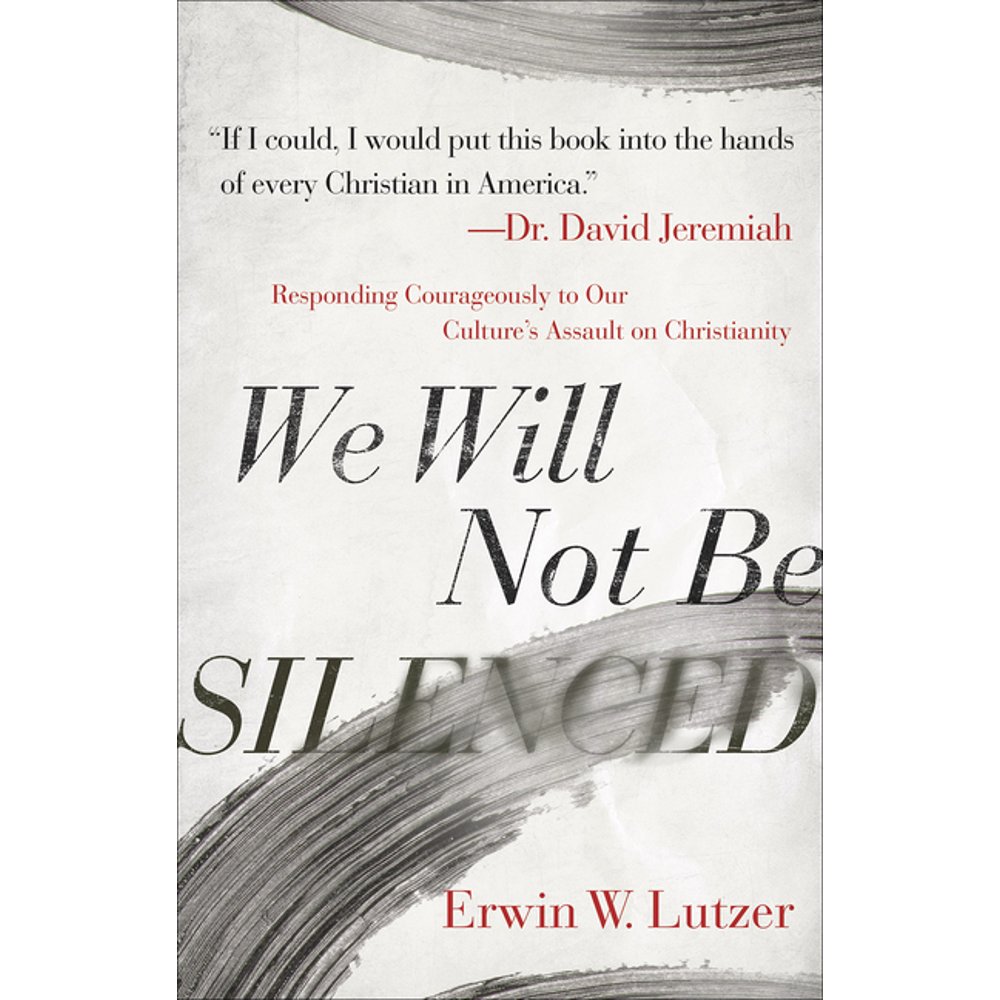
A critique of Erwin Lutzer’s “We Will Not Be Silenced”

I recently finished reading Pastor Erwin Lutzer’s book “We will not be silenced”.  I was given the book as a gift by a relative, in response to some of my opinions on the subject of Black Lives Matter, Covid-19, and my thoughts about former President Trump.  The intent, I believe, was to show a Godly, Christian view of the many things happening in American culture.  I was already familiar with Lutzer, as I’ve listened to many podcast devotionals from him over the years – in the past, I’ve appreciated his points and have benefited from listening to him.  I would say that I had even respected him, as a pastor.  After reading his book, however, I am having to rethink my perspective of him.  In what follows, I will share my thoughts and opinions in a critique of his book.  Lutzer covers a lot of ground in this book, sharing his thoughts on BLM, Islam, LGBTQIA, among others.  I found myself shocked to hear him say a great many things in his book – and while I’ve focused on some of the most egregious things he says, there are plenty of other thoughts in his book which I’ve left unaddressed but are congruous with the disappointing worldview which he exposes to his readers.  In critiquing his work, I think it would be helpful to define criteria to determine whether statements from Lutzer are trustworthy, accurate, or loving.

Those criteria are as follows:

  • Dr Lutzer claims that science proves him correct on many issues. If we find that science, in fact, does not support his claims then we should consider that his ideas relating to science are also unreliable.
  • If he misrepresents the perspectives of groups of people with whom he disagrees, then this calls into question his knowledge and trustworthiness, and should serve as a detriment to his credibility.  
  • In places where he gives anecdotal examples of societal issues, if he fails to address the opposing perspectives, we should as Christians ask whether he is truly acting in love.  We can question whether he is truly acting in good faith with the perspectives he brings to the issues at hand.

One of the primary themes that runs through the book is that of race relations.  While race relations seems to be his obvious motivator, his overarching strategy is to discredit anyone who disagrees with him by labeling them a Marxist – which it seems in his view, is about the worst thing ever.  His attempts to do this amount to little more than trying to point out how Marxism has an element that desires to correct power differentials – and then attempting to link the similarity between White privilege and attempts to rectify it in our own society to being in line with Marxism.  This, and falsely positing that those who want to correct this want the government to control the means of production, etc(p184).  His arguments are more or less just assertions of opinion, which themselves seem to be designed to gin up fear and anger in his readers, who likely are already familiar with topics being addressed in this fashion.  The main difference being that in this book, there are a couple of scripture verses strewn throughout, as well as some very half hearted (albeit short) admonitions for trying to be respectful and compassionate when engaging with those on the left(p116,123,124).

In addressing race, he seems interested in absolving himself and White Christians everywhere from the stinging charge of being called racists(p85, 115).  I believe that there is a self-conscious shame that permeates his writing, and it comes out in self righteous denial of wrongdoing.  For many Christians, our “Christian bubble culture” is one in which we are accustomed to meting out indictments on the rest of the culture at large – be it homosexuality, sex out of wedlock, abortion, violence in culture, pornography, gambling, drinking, dancing, smoking, chewing, swearing, etc.  It truly is a mindset which frames everything in terms of “us vs the sinful world which desperately needs our help”.  This sets up an interesting problem (among others): what happens if and when the Christians get it wrong?  What happens if, despite their best attempts at “being in the world but not of the world”, something from the world, something highly immoral makes it into their culture?  What if it’s been there so long, and has so shaped their thinking, that it feels normal or right to them? What would happen if they were to be confronted with it?  Do they have a framework of humility and self-reflection that, regardless of the source, when presented with an indictment of behavior, are able to process it graciously and with penitence?  What if they don’t have a framework or experience dealing with egregious church culture failures?  How might they respond?  They may be tempted to respond with indignation, anger, recrimination, and incredulity, something along the lines of “How dare you!?”. Not only this, but the charge would feel so foreign, so outrageous, that after scoffing at it, it would probably be ignored and dismissed as lunacy, with no real need to engage it constructively, and no real need to try to discern if maybe there is something that needs to be pondered on a more serious level.  Which brings us to Lutzer’s book – and almost immediately, he defuses the “race card” bomb – by decrying at the outset that he’ll probably be called a racist because that’s what happens when you try to engage in good faith on this topic(p20,81,85,108).  He says that leftists want to silence Christians, because as he states elsewhere, the leftist agenda can’t stand against reasonable arguments, debate, science, etc(p29,33).  He then shares how a White NFL quarterback got in trouble for saying that Black football players shouldn’t kneel during the national anthem (105).  But Lutzer doesn’t address or interact with why people are engaging in this noteworthy behavior, even though as a self professed good faith debater that would be the expected course of action. So despite accusing the left of not wanting to have good faith arguments or spirited debates, he totally avoids addressing the true issues at hand.  So I will touch on some of the points that he curiously didn’t visit – because I get the sense that he hasn’t done even the most rudimentary investigation as to what is going on before condemning it outrightly.  Pastor Lutzer, the problem is that Black people in this country suffer disproportionate amounts of violence at the hands of police.  And at the risk of sounding pedantic, let’s talk about what disproportionate means.  Let’s say that White people make up 50% of the country, and Black people make up the other 50%.  If police violence hurts/kills/affects 10% of people, then both Blacks and Whites would be expected to be equally affected – that is, of those affected, 5% would be Black and 5% would be White (together making 10%).  If, on the other hand, we found that 9.5% of Blacks are affected, and only .5% of Whites are affected, we would say that this is disproportionate, since it doesn’t match the demographic makeup of our population.  And this is precisely the problem we have in the United States.  In the US, 13% of the population is Black, and 61% is White.  This means that we would expect police violence to generally affect the same proportions.  However, we find that armed Black men make up 25% of those killed, and unarmed Black men make up more than 33% of those killed.  Lutzer conveniently ignores this, even though it gives a powerful explanation for the protests and the intense focus on the police and their funding.  To discuss these issues, as Lutzer has done, and not deal with the disproportionate violence against those who are Black is to not engage in this subject in good faith. So we have to ask, how could Lutzer miss addressing such an obvious point like this?  Even the most rudimentary and half hearted search for information about BLM protests or kneeling during the national anthem would inform the curious party to this and other points.  I have to wonder, did he not try to find this information out himself, or did he know and choose not address it?  If the former, then shame on him; it would be extremely lazy and disingenuous to feed people your uninformed opinions and would require repentance for misleading people through omission.  If it is the latter case, we need to ask, why did he not address it, as this is foundational to what critical race theory (CRT) says we should be able to see if it is correct in its hypothesis that our society is fundamentally set against our Black citizens.  If he thinks that these statistics are unpersuasive, then it would behoove his position to state why they are unpersuasive, and would deal a critical blow to the so-called leftist ideology he opposes.  So we are left wondering – did he omit this discussion by accident, and therefore miss a golden opportunity to destroy a liberal argument, or did he exclude it because it was damaging to his own arguments?  I do hope it’s not the latter because if it were, this would demand him to repent and acknowledge a certain purposeful deception in order to bolster his own arguments – and deception is not a very Christian thing to do.  The truth is, that these statistics show not only an ongoing problem, but are indicative of one which has been going on now for the last 322 years or so.  And this problem is one of White supremacy – a problem which Lutzer does his best to steer well clear of in his book.  It is the reason why so many, like him, take issue with anyone standing up for the mistreatment of our Black citizens.  And the classic way to avoid it is to redirect it – with the aforementioned criticisms of those who kneel, protest, etc.  The disproportionate violence against Black people, when honestly considered, raises some other uncomfortable questions.  Why, as a society, are we so indifferent to a people suffering disproportionately, and how has this been allowed to happen in a society which espouses equal treatment under and by the law?  Might this, like a wet, moldy spot on drywall, indicate that there are other more insidious and structural issues beneath the surface?  Why do we get so defensive at the idea that our society might have racism built into it?  Is this a result of willful negligence, a practiced indifference which expertly places blame on any who would question it?  Lutzer illustrates this effectively by his portrait of the White QB.  Rather than allowing the spotlight to shine on the unjust suffering of a group of people, Lutzer redirects attention to the poor White QB who said something foolish.  And this is the name of the game, distract from the issue at hand (murder, violence, poverty) and focus attention and sympathy on the oppressor.  This effectively prevents society from learning from its failures and instead helps to bolster its flawed position and prevent change for the better (for nothing will change if there’s not a reason to change it).  Any attempts to get society to take notice and change are rebuffed in this way and others, helping to ensure that the thoughtless and callousness of our society will continue on for another generation, as it has for many past.  An important question to consider, is why doesn’t Lutzer, or other Christians at large, care to investigate or consider whether these injustices are real?  Why are the pleas for change so often dismissed outrightly and with such contempt?  In my opinion, it is because they have put secular political perspectives above their loyalty to Jesus Christ, and have decorated these ideas with Christian lingo.  This allows them to proceed with the false confidence that their actions and words are biblical and as such, outside of the realm of that which may be questioned.  If they allowed themselves the opportunity to self-reflect, they might recognize their error, and start asking other important questions.  Questions like what other areas of our society display an indifference to suffering, or what other aspects of society are systemically unjust?  These seem like questions which are in the purview of Christianity – albeit, a Christianity that isn’t beholden to a political party.  These are questions which are naturally raised when we see athletes kneeling on a sports field.  We might also ask what it says about our society that for over 300 years, we’ve been so indifferent that it takes such very public acts to get people’s attention?  And rather than address it, people still find ways to ignore the actual issue at hand and turn it around, as though the behavior is offensive to them!  Seemingly incensed at the racial issues being brought to bear in the culture, Lutzer rails against people removing statues, the calls for Jesus to be removed from stained glass windows, and accuses those who call for change of wanting to stir up racial divisiveness and destroy America(p42,46, 72, 74).  He makes almost no attempt to consider why people want to remove statues or Jesus from stained glass windows – it’s hard to imagine that a man who feels strongly enough about these issues to write a book about them doesn’t actually know the “why” behind them.  Even if he disagrees with the “why”, his lack of serious engagement with any counter arguments suggest his purpose – to justify himself, and the Christians who look up to him, for continued apathy and further cultivating the acceptance of the church’s culture of racist White supremacy.  Briefly, I’ll touch on the “why” which he failed to address.

Many statues which are being brought down were put up originally by overtly racist organizations, like the Daughters of the Confederacy.  These groups put them up after the war for the purpose of furthering racial terror, as a kind of menacing message to recently freed people after the civil war.  This was done against a backdrop of hundreds of vigilante mutilations and killings of Black people throughout the country, but especially in the South – also known as lynchings.  These killings were mostly left unprosecuted, even though everyone knew who was responsible – in many cases, there were crowds of people who gathered to enjoy the spectacle, who reveled in the violence and would pose for pictures and take souvenirs, in the form of mutilated body parts when the gruesome crimes were finished.  Of the countless hundreds (or thousands) who watched, I can guarantee there were many Christians.  When statues which depict those who facilitated or participated directly in human enslavement are targeted for removal, it is usually not even for destruction; the idea is that the statues (because they are historical), should be moved somewhere where proper historical context can be given about the statue, including but not limited to the reasons for its controversy.  That is, the statues shouldn’t be glorified, but rather shown in the proper light, with information about what they’ve done, both good and bad.  Additionally, and I would presume, most importantly to any pastor worth his salt, by removing the statues from the very public spaces, they can be prevented from inflicting any more emotional harm on those who still suffer consequences from not only enslavement of their ancestors, but who have to deal with on a daily basis the very real affects from chattel slavery which is still felt in our society today.  As a White gentleman, Lutzer may not have first hand experience with the pain involved in seeing confederate/slave holder statues – but there’s nothing that should prevent him from empathizing with those who do.  By addressing the statue controversy as Lutzer has done, he is essentially whipping up ire in his readers by presenting the issue in a hyperbolic fashion, leading them to assume the worst rather than treating the issue in an even handed and reasonable manner.  He is acting as though his opponents desire for all statues, even of the founding fathers, to be destroyed – and this is simply not true.  This is all done while minimizing the impact of the statues, painting, etc to people of color.  To me, this is the definition of arguing something in bad faith.

Now for the stained glass Jesus.  Lutzer gripes that the “leftists” want to remove depictions of Jesus from stained glass windows(p46).  While that is a very impactful and offensive concept to Christians, it’s important to (again) mention what the reason is that people might be advocating for its removal.  In fact, not mentioning it again paints Lutzer in a negative light, as one might wonder if he is being purposely misleading.  The reason for removing the depiction of Jesus is because of its’ linking with White supremacy.  Jesus is depicted as White in much of our culture, through paintings, pictures, and stained glass windows in some cases.  The problem is that Jesus is a Jewish man from the Middle East – not a White European.  This isn’t a new revelation and you don’t really need an advanced degree to know this – also, it’s not something that we’ve only recently discovered.  So, why have a White Jesus?  Because, White supremacy is baked into our culture, and also into the church – so much to the degree that we don’t even think to question it.  And when someone does question it, our self-righteousness and moral superiority well up to defend us and attack whoever would dare to question our moral standing.  As I’ve mentioned before, Lutzer is responding to a perceived attack on his moral standing, and Christians do not have a category for a legitimate critique of their group wide moral failures.  Rather, the response is a reflexive attack on the source of criticism, instead of a humble consideration of whether the critique has merit.  The point is that the conversation is not as simple as Lutzer would lead us to believe – but since it hurts his position, this concept is conveniently omitted, as he has the habit of doing for many of his points.

There’s a pattern Lutzer uses throughout his book which goes like this: he outlines a grievance with a group, omits their side of the story, and then tries to link them to Marxism or secularism.  The grievance may take many different forms, but ultimately he posits that the outcome will be the transformation of America as we know it to Marxism, the silencing of Christians, or the breakup of the nuclear family unit(p21, 22, 42).  Regarding the silencing of Christians, this trope has existed within the Christian community for some time.  Despite its prevalence, what I’ve noticed is that more often than not, people don’t want to take away their freedom of speech; rather, we want them to speak the truth, and argue in good faith.  Oftentimes when a person faces blowback for saying something, or “gets silenced”, they’re not actually having their free speech stepped on and they’re certainly not getting silenced by the government.  Rather, companies choose not to air their nonsense.  Or people choose not to engage with them.  There’s a great comic by XCD that I remember reading years ago, and as a conservative Christian, it made me angry. 
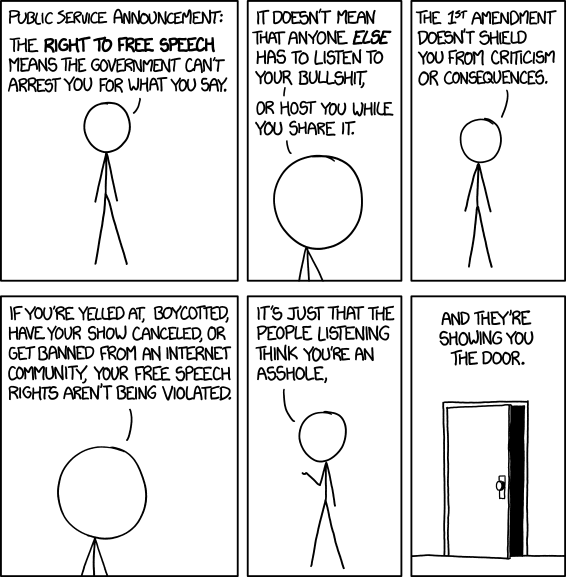
Comic by https://xkcd.com
by https://xkcd.com/1357/

It’s interesting because the comic doesn’t actually mention politics or religion, yet I sensed that it was a polemic against my beliefs at the time.  It stuck with me, and over the years, when people would say controversial things, or I thought about things I might like to say, I would think about that comic.  I would begin to wonder, “Is what was said actually something that should be said?  Is it actually a good thing to say?  Is it actually a true thing to say?  Is it ignorant or well researched?”.  Over time, I began to realize that, in fact, no, those things that were said were often just genuinely offensive and made people angry because they were the words of a person who was ignorant, or couldn’t be bothered to reflect genuinely on their own thoughts, or interact in good faith with other ideas.  So when Lutzer complains that Christians are being silenced, ask yourself whether that’s true or if it’s not just that people, to paraphrase XCD, are showing you the door, because they think you’re being an a**hole.  While admittedly crude, what he genuinely needs to ask himself is, “Am I being one?”.

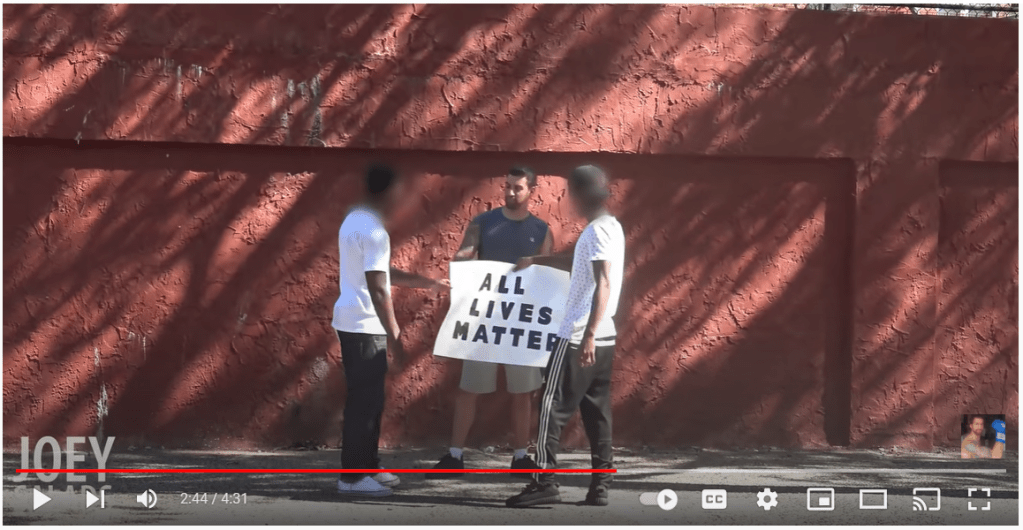
Rather than continue to multiply examples of the pattern mentioned above (because there’s only so many times I can say that he’s trying to link progressives with Marxism), I’d like to shift focus to highlight some of the dubious things he mentions, which I hope will paint a picture of the type of person he expresses himself to be.  Lutzer says that “humanists” want open borders for the purpose of diminishing “White culture” and to create dependence by giving free housing, healthcare, and other free things in exchange for votes(p59).  Who the humanists are, I’m not sure – however he also snidely comments that they do this under the guise of compassion and justice, so I take it he’s not talking about his own crowd – which is odd, since one would expect to find compassion and justice as the cornerstone of his politics.  He immediately links this fictional immigration scenario with sex traffiking, drugs, and gangs, which probably wouldn’t cause anyone in his camp to bat an eye, but the problem is how incredibly ignorant, and yes, racist it is(p58, 59).  Speaking of which, he references violent crime in Black neighborhoods to ask sarcastically whether “ALL Black lives matter” (61), which is basically a combo move for White people who want to denigrate the Black Lives Matter movement – he combines the “whataboutism” of “what about Black on Black crime” with the ignorant phrase “All lives matter”.  Well done, Pastor Lutzer, you are obviously well versed in White fragility.

In what I would describe as the most shameful portion of the book, Lutzer makes the case for inequality (p77).  He does this using the parable of the talents, saying that there are some people who are given more [wealth] and therefore prosper to a greater degree.  He goes on to say that there will always be inequality, and all we can do is ensure equal opportunity, but we must not expect equal outcomes.  And while he admits that minorities are often faced with greater obstacles and challenges which we should fight to remove, outcomes are dependent upon the skill and talent of the individual.  Please don’t miss this – what he is doing here is trying to account for the enormous wealth gap between White and Black families (this is also highly disproportionate in demographics) – and I interpret his explanation to mean that he believes White people are superior in their talents and skills.  This is further shown when he enthusiastically quotes Jude Dougherty, who says: “Men differ in strength, intelligence, ambition, courage, perseverance and all else that makes for success.  There is no method to make men both free and equal”(p78,92).  Despite how utterly shameful this is, it really gives insight into his perspective on race, narrow as it is – and likely insight into how many other White people think as well.  While not surprising, it does make me wonder if they are consciously aware of the implications of this line of thinking?  If they are not, the possibility exists that once made aware, they might in sorrow repent for this deplorable belief.  If in fact they are aware of their thinking then I’m not sure why they would bother decrying the label of racist – they should just embrace it.

Lutzer makes clear that he believes that talking about race issues is divisive, and that doing so seems to make things worse(p73, 74, 80).  At the same time, he also (very briefly) concedes that systemic racism exists.  What he fails to mention is what form or shape this takes, as well as the vital question of “how can we determine if there is systemic racism?”.  He rails against “The 1619 project” as well as Critical Race Theory – two vital tools useful in identifying systemic racism.  But he claims that these things have a goal of “causing people to hate America” as well as causing the complete erasure and destruction of democracy as it stands today(p42, 50).  He also believes that it causes us to focus on all the bad things that the founding fathers have done to the exclusion of any good that they’ve done.  And, according to him, they’re merely tools for the secret agenda to convert our country to Marxism, apparently.  But as someone wise has said, “focus on what they do, not what they say” – this will keep us focused on what the real issue is.  Lutzer tries to exclude those tools, as well as clamp down on talking about race in general.  He says that we’ve made great progress in our race relations, and that all this talk of inequity and racial strife is setting us back.  He would prefer that we just focus on making sure everyone has equal opportunity, as outlined in our constitution, so that people are responsible merely for themselves and their actions alone.  He doesn’t want people talking about issues related to race.  As a fellow White person, I can understand why he might think this is the right approach.  We typically get the benefit of the doubt in situations, and we get to go through life thinking that race doesn’t exist (or at least not be impacted in a negative way due to the concept of it).  We live in a culture where the default idea of “human” includes Whiteness.  He and I will get the benefit of the doubt when in a store, or walking somewhere late at night, or during a traffic stop, and we won’t think twice about what it might be like not to have this, since we’ve always had it – after all, it’s easy to do this with something that you have just taken for granted for your entire life.  We get to assume that everyone else goes through life exactly as we have, and so it’s no wonder why talking about race or the benefits of Whiteness is strange and uncomfortable for him.  While he can’t be faulted for not discerning these things on his own, I fault him with willfully leaving the blinders on after he’s been told he’s wearing them.  CRT, 1619 Project, protests, kneeling at sports events, movements to defund the police are all tools, hints, and warnings that we have (White people) been walking around with blinders on.  To ignore these things and to embrace the blinders is cause for fault for all who do so.  More so for Christians.  And to a much greater degree for Christian leaders in the church.  Regardless of whether you are laity or clergy, we know the error of the Pharisee – so sure of their own righteousness that they disdain and hate those who would inform them of their own sin.  And that is precisely what any Christian who refuses to look into these things is – a Pharisee.  To be offered the opportunity to know that one has unintentionally participated in a culture which systematically oppresses others and to defiantly defend that participation rather than moving to repentance is a spectacle powerful enough to make me question my own faith.  Indeed, Lutzer is not alone; an enormous portion of evangelical Americans have joined forces with Republicans in this defiance, to the point where I can’t distinguish one group from the other.  It has made me consider, if, perhaps, Christians at large can be so radically unloving, that maybe it is just a man made religion?  For now, what keeps me here is the assurance that our culture’s treatment of Black people is wrong according to a universal standard, and I think that true Christianity does point at a truth which is outside ourselves.  Maybe true Christianity exists somewhere other than where I’ve previously located it.  Maybe Lutzer, et al, are merely showing me how deceived I’ve been in my thinking about these particular strains of Christianity which I’ve been formed by.  Maybe they are not quite the gatekeepers of truth that they profess themselves to be.

Based on what we’ve covered so far, I’ve come up with a thought experiment for Lutzer and others who rail against the legitimacy of findings of oppression within our culture.  That experiment would be for them to imagine themselves living during different eras of our American history; there are several to choose from, and they should try this for them all.  Pre civil war: imagine you are a regular church attender, and are living in the North and/or South – would you be an abolitionist?  Would you be an integrationist?  (Meaning, do you think that Black people should participate in society with the same standing as White people, mingle in the same social circles, etc?)  Do you think that this question is a no brainer?  Do you think you would know better than your peers and would you go against the prevailing culture of the day?  Do you think that all Christians during that time era would have the same opinion that you, as a modern person does (i.e., abolitionist and integrationist?)  Here’s something that might shock you; while many in the North would have been abolitionists, not as many would have been integrationists.  If you went to Jonathan Edwards’ church, would you pull him aside and tell him that he shouldn’t own slaves?  Would you tell the other northerners who attend church there?  If you lived in the South, and were well acquainted with their Biblical justifications for slavery, would you share your contrarian opinion, even though it would go against what your pastor and elders might teach?  How about during the late 1800’s or early 1900’s – would you stand up against Black people being lynched by a crowd of White people?  (Incidentally, if you did stand up for them, would there be other Christians standing by your side?)  How about if you lived in the mid 1950’s?  Would you stand up against ‘White’s only’ signs at water fountains and bathrooms, or protest bus companies with prejudicial seating?  If you said yes, that’s great – but what allowed you to rise above the cultural current to hold a viewpoint which was so different from the other well meaning Christians of those eras?  How could you have possibly discerned that what you grew up with, that what seemed “normal” to you was actually at odds with what was right and just?  The point is that we probably wouldn’t have acted or thought differently than those who have gone before us.  There’s no reason, whatsoever, to believe that we would in fact know better than them – we must realize that we are them in as much as we are unable discern our culture while being immersed in it, much like fish are unaware they are even in water.  Once we accept that we are no different or better than our predecessors, we are in a much better frame of mind to ask – “If they could live with such obvious injustice and not know it, isn’t it possible we are doing the same thing?  What else might we now be missing?”.  Further, it is not a stretch to expect that whatever has been present in the culture for over 300 years, from the nation’s founding to the 1970’s, for instance, would still be present today.  Thankfully, there has been much study around systemic racism, and there are tools that can be employed to help expose those cultural aspects which can be so difficult to perceive.  The problem is that those tools are being demonized so that their findings will be ignored.  We are told, by Lutzer, that what is uncovered will cause people to hate America, cause Christianity to be outlawed, and take away our freedom of speech(p42, 50, 105, 117).  This shameless exaggeration makes it apparent how impervious the culture is to change in this regard.  The hyperbole is really unparalleled – where else and for what other topic could one hear such defensiveness at merely pointing out a deficiency or problem?  When one visits the doctor for an ailment, and the doctor utilizes an x-ray, CAT scan, or some other diagnostic tool, who in their right mind would accuse them of hating the patient?  Or of wanting to erase or silence the patient?  Or who would accuse the doctor of being a Marxist?  Those would all be non sequiturs, but that is ultimately what some Christians are doing with their attack on CRT and other research/writings about race and injustice in America.  On pages 89-91, Lutzer gives a more detailed view into what he really thinks on this subject, and it is chilling.  He shares two quotes which go on to say that we’ve created a permanent group of victims who have become dependent on government handouts and freebies, preventing them from being motivated to better their own circumstances.  He seems to think that they employ a victimization that allows them to have “unearned privilege”, which sounds like a perverse analog to White privilege.  He mentions dismissively that he believes in systemic racism, “which is variously defined”(p89, 90), although he later says that there have been systems in place that favored inequities in the service of systemic racism.  So he is very lukewarm to the idea of systemic racism as a concept, and doesn’t seem to think it has much impact anyway, due to the very limited extent that he speaks of it.  Lutzer advocates that things will get better if we can just sit down, talk, and listen to each other in earnest.  The problem is that immediately after this he goes on to rail against the idea that some standardized testing is inequitable to students of color, and how horrible it is that some curriculums are imbued with critiques of western colonialism and the ways in which it passes on unequal power structures(p91).  You see, he might want to sit down to talk about race issues, but he doesn’t seem to show an interest in listening, judging from the one sided engagement with the topics he covers.  It’s no wonder why he is so perplexed by the protests, people kneeling for the national anthem, or people talking about race – he refuses to be quiet long enough to actually hear what people are trying to say; if he does take his fingers out of his ears, it’s only long enough to dismiss opposing concerns or perspectives as marxist, radical secularist, or evil.  There are plenty of legitimate and common sense answers to his grievances, but you wouldn’t know that from reading this book.  He implies that talking about race causes race problems, denies that CRT is valid, and yet somehow agrees that systemic racism exists (p91).  What he fails to recognize is that CRT is actually a tool that helps to identify systemic racism.  Not content to accuse people of being lazy victims, he goes on to say that the Black community must be accountable for the problems caused by their own community (p92) and then uses a quote from former President Obama as support for this line of reasoning.  (The quote had to do with the rising problem of fatherless households, men who don’t take responsibility for their families).  I would contend that while this is certainly an important topic, there is no one actually arguing against accountability!  Rather, this is lazily thrown out as a red herring.  It is out of place and merely illustrative of Lutzer’s failure to take seriously the reality of what we’re told the Black community faces while living in a White supremacist culture; a culture which, as Lutzer illustrates, is all to happy to point blame in any direction except toward the itself, skillfully masking and protecting White supremacy using its’ most effective tactic – pretending like it isn’t there.  Lutzer wraps up his discussion on CRT with what I imagine is his version of a mic drop: that Black people’s problems “are the result of a sin problem, not skin problem” (p96).  This is the destination to which he has been driving with all his blame on the Black community, denigration of various forms of protesting, and accusations of Marxism – individual sin is apparently the primary thing that we should focus on, not all the “political” stuff.  He desires to absolve White people of any potential responsibility, so long as they are being “nice people” who don’t use the n-word or treat people poorly because of the color of their skin.  If it’s only a sin problem, framed on individual responsibility, then we can just focus on ourselves as individuals and there’s nothing we as a society need to change – no laws or curriculums or statues or paintings need to come down.  Things can stay the same, since we don’t have any overtly racist laws anymore, and so all people have the same fair shot at being successful.  We don’t have to reckon with all the dubious privileges our country and White folks have, or how we got them.  I find it ironic that so long ago, many churches “opted out” of talking about the race issue by saying that it was a “political” thing, so they’d just let the politicians handle it, allowing the churches to just focus on spiritual stuff (while keeping their unity) – they could just focus on things like bible studies and Sunday school.  Lutzer channels that same abhorrent apathy that has been used by the church for centuries to support the effects of White supremacy – and he gets to feel spiritual while doing it. 

I have written before on the Christian COVID-19 failure – it seems that Lutzer fell right in line with the prevailing foolish political bluster in this area as well.  I want to quickly highlight some of the things he covers here, as it will be in service to a later point.  Lutzer takes issues with masking, imaginary vaccine databases, and contact tracing (137,138,178,191).  He also tries to make it seem like it was the goal of some politicians to cancel church services, and that our compliance  was borne out of fear – and this somehow shows we don’t deserve our freedom.  When I wrote about the Christian’s response and failure, it was prior to the general availability of vaccines.  While vaccines were only in the development and testing phase when his book was released, he apparently had already bought into the future Republican strategy around vaccines.  That strategy is basically the same one employed by Republicans for anything which is science based: do and say at all costs, the opposite of what science and experts on the subject deem best.

Speaking of science, he makes fun of climate change, saying that laws and policies are rooted in, you guessed it, marxist beliefs rather than being based on evidence – he offers no examples, but seems to be pretty sure that it is all a fiction (p185, 186).  Likewise, he speaks dismissively and ignorantly about those who care for the environment while tempering his criticism with little more than half hearted admonitions to care for God’s creation.  He also claims that evolution is one of the false things that children are taught in public schools when speaking about the dangers of secularism (23,185).  So covid-19, climate change, and evolution – what do all of these have in common?  What we know about all of them is thanks completely to science!  Lutzer accuses his targets of disagreement of being unwilling to listen to science or debate their position.  The positions he holds on all these subjects show that it is he who is estranged from science and the facts it reveals.  His attempt to deploy it in service of his position is ironic, and disingenuous.  He shows a complete unawareness for how far departed he is from reality – which in my eyes, destroys his credibility to be able to speak eternal truths to others.  As such, when he makes the case against gender dysphoria, claiming that it has no basis in science, his claim rings hollow(p164).  For if he were to research it and actually attempt to find something scientifically related to the subject, he would learn his statement is not accurate, and that things are not as simple as he would like them to be.  Interestingly, he mentions a study which suggests that 80% – 90% of transgender children end up identifying with their birth gender – however, what he doesn’t mention is that a majority of those kids end up identifying as gay or bisexual (p167, article).  Which makes it a strange study to be mentioned, as the outcome still ends up with people embracing a lifestyle which Lutzer would find unbiblical.  But, it’s clear that for much of his book, he has done little by way of interacting with the relevant sides of many of the topics with which he takes issue.  He admits as much during his discussion of Rachel Held Evans.  While he seems to know of the impact of her work, and takes issue with a foreword she wrote for a book which he finds objectionable, he admits that he hasn’t actually read much of her work(p251).  One wonders what other opinions and thoughts expressed in his book were formed with such diligent research?

“We will not be silenced” is a disappointing yet accurate example of the way that influential Christians in America can drive a toxic narrative in our churches.  While the thoughts and points Lutzer brings up are disturbing, my experience of growing up in the Christian church (albeit the rightward leaning part of it) prevents me from being surprised by much of it.  The thought patterns are consistent with a worldview which I believe is effectively maintained and transmitted to congregants – most of the arguments in the book are ones which I or anyone else raised in the church could easily generate, even without very much study – we would probably just go out and look for sources which back up our opinions after the fact.  Many of them would not even require being a churchgoer – they are rooted in a modern Republican ideology – Christians are merely able to “baptize” it so that it sounds respectable and bible based in their respective fundamentalist circles.  The saving grace, I believe, might just be Christianity itself.  Ultimately, my relationship with Christ, the biblical belief that we must love others, and the belief that lying is wrong, helped me out of a toxic political narrative.  It forced me to ask if my political belief system caused me to believe unloving things about others.  It reminded me that before I get angry at a news article, I should verify if what the news article is relaying is actually true.  It helped me struggle through the questions of whether evolution was true, and follow the evidence despite the hardship and uncertainty it caused.  When I utter statements, it reminds me to ask myself if what I’m saying or posting is truly accurate, because doing otherwise would be to lie.  These sound like simple, no brainer things.  While they are simple, I’ve found that practicing them is harder and more uncomfortable than it sounds – but the fruit of doing so can be transformational.  In his book, Lutzer hits all the main notes of the things that get those in the church fired up and ready to vote – unfortunately, he has also exemplified the dogmatic argumentation and lack of circumspection that I believe are turning off an entire generation of people from the church.  He demonstrates a stubborn thinking that seems to believe it has all the answers and so doesn’t need to question whether it might, in fact, be wrong about some things.  It is thinking which seems to cloak its own ignorance in haughty self assurance while claiming to be biblically based.  It is thinking which sadly fails to realize that wrapping Christian language around a profane political ideology makes Christianity appear as distasteful and profane as the ideology itself.  It is a thinking that seems to value political power over truth and love – and one which  treats reality as an optional feature of a worldview.  In my opinion, he would do well to be silent a little more often and listen a whole lot more.

Page numbers reference the paperback edition of the book “We will not be silenced”, Copyright 2020.

An example of how Fox News pushes propaganda

I recently read a Fox News article and I was inspired to write about some thoughts I had on it. It was really shocking to see how brazen the propaganda was, but since it might not be obvious to everyone, I thought I’d share some of the reasons I believe it is. The article’s headline states the purpose is to inform the reader “CNN heavily promoted Rebekah Jones’ fake conspiracy accusing DeSantis admin of altering COVID data”. 

What I’ll show is that Fox’s actual purpose can be understood as follows: “Cast doubt on Rebekah Jones, rip on Chris & Andrew Cuomo, and elevate Governor DeSantis to the Republican audience”. That’s a mouthful, but they cover a lot of ground in a super short article. I’ve outlined the article below:

  1. State a sensational takeaway as headline (and then summarize someone else’s opinion)
  2. Get to the true reason for the article, which is to take cheap shots against people/issues (which are not relevant to the article)
  3. Omit things which should be included in a news article

Sensational takeaway

The article in question is about Rebekah Jones.  Jones worked on the covid-19 dashboard for Florida, and was apparently fired for refusing to change the positivity numbers from 18% to 10% (the state’s target reopening metric). The article opens with Fox News giving readers a preview of what their true purpose is – attacking CNN. They frame the discussion by saying that all media outlets (especially CNN)  swooned over Rebekah Jones based on her allegations, which seemed to indict Governor Ron DeSantis.  They then take a rather strange turn, and start quoting from an article written by a conservative editorial magazine (National Review).  It’s interesting because they can merely state what they’ve read in the article, like a book report.  They can then relay whatever claims it makes without any liability for false statements/accusations, because they make it very obvious that the info they are reporting is coming from an article, which they label as a report. Something to note is that they do not call out or label what the National Review is, nor do they preface it with the fact that the report is actually an opinion piece, and not any researched journalism.  I think this is dubious, but very clever — they can say anything, and ostensibly are protected from any potential libel, since they can claim that they are not saying it themselves. They also can covertly sneak in some opinions while dressing it as “news”.

The Fox contributor, Joseph A Wulfsohn, makes no effort to verify (or at least does not inform the readers of such efforts) any of the information that comes from the article which he cites, and he makes no effort to talk to Ms Jones herself, or anyone else involved in the story.  In fact, there is nothing in the article which suggests that any of the information is actually verified, original, or newsworthy. For that matter, there’s also no evidence that the author performed any work related to the story at hand, other than counting how many times CNN ran reports about Ms Jones.  It’s basically a written form of gossip (i.e., hey, did you hear what so and so said about so and so? Well, I’m not saying that X is true, but this is what I heard).  Anyway, it is pretty clear this is not news.  This is gossip, masquerading as news, but with a more sinister intent.  The intent is to influence their readership by using their dubious position as a news source and peddling worthless and unactionable information.

Get to the true reason for the article

Once the author is done relaying what he learned from the opinion piece in the National Review, he segues into his primary purpose for the article, to rip on the Cuomo brothers.  He transitions by mentioning that Jones has been interviewed by Chris Cuomo 5 different times.  Here he says that CNN “pushed the narrative” (I think he meant to say “reported on”) that she was a victim of a police raid due to Governor DeSantis’ retaliatory action towards her for trying to tell the truth.

The author uses this point to bring up the super obvious fact that Chris and Andrew Cuomo are brothers, and that during interviews with one another, they tended to be pretty friendly toward one another.  The brothers were “chummy”  with each other, and the way the author writes this is clearly intended to draw scorn from the readers for this fact. He then goes on to relay how CNN has said complimentary things about Governor Cuomo’s handling of the pandemic in the past, and that now Chris is in a tough position due to the scandals now swirling around Governor Cuomo. (Pause here to appreciate how far from the headline topic we’ve strayed!) He finishes the article by stating with ridicule that Chris has said that he “obviously” cannot cover his brother – with the author implying that Chris is hypocritical for covering him during the early part of the pandemic.  He fails to mention that Chris said in the next sentence that CNN has and will continue to cover the stories about this brother. It’s pretty obvious that it wouldn’t make sense for him to cover his brother’s troubles on air – this doesn’t seem unreasonable, although the author seems to understand that his audience will likely take the cue and scoff at this as typical hypocrisy.  The author also appears to tip his hand to one final purpose of the article: to gently suggest to his readers that they should get on board the Ron DeSantis train. He does this by informing them that DeSantis’ “national popularity has been rising among Republicans”. This indicates to me a forewarning of who the author, and possibly Fox News will be backing in the next round of Republican primaries.

Omit things which should be included in a news article

One of the reasons I think that it is easy for readers to fall prey to Fox News articles is because it is difficult to detect what is actually missing from the articles, not just what they choose to include.  For instance, the author doesn’t try to make any contact with anyone involved in the story — at all.  This is a huge red flag – any normal news article or journalist will use sources of information, facts, interviews to describe the subject at hand.  This article does none of that.  The only source is an opinion piece by a highly partisan news source. Contrast this with a CNN article which outlines Jones’ arrest. The article has quotes from the FDLE which detail the reasons for her arrest and the charges which were brought against her. It also contains quotes from her which mention her perspective of why she was arrested, and the subsequent lawsuit she is bringing against the FDLE. There are then links to other stories which talk about DeSantis’ handling of covid-19, some from CNN, and some from other news sites. The point is, there are sources of information which show an attempt to give a good faith representation of what is happening from multiple perspectives, and the use of multiple sources allows the reader to get an understanding of the breadth of the issue while also allowing them to research pertinent points at a later time.

Another important aspect which is missing is a good faith attempt to look at things from a different perspective, namely Ms Jones’. For instance, after describing the “devastating piece” which Cooke wrote, a normal news article would then have also shared information which gives an alternate position or given some statements from someone who has reason to believe the report is false, or at least outline what problems there may be with the article. None of that is given, whatsoever.

Fox News took a very devious but clever approach to inducing suspicion in its readers all the while staying pretty safely away from making actual accusations or revealing any facts to corroborate what is reported.  They used a gossip technique used by the expert gossipers – relay something dubious that they heard from someone else.  They keep their hands clean (sort of), because they didn’t actually say anything false — they just told us what they heard or read somewhere.  It’s devious because they are acting like it is news, but not actually doing any of the legwork associated with writing a real news article.  They get website hits (and money from advertisers), and they promote anger, as well as their preferred partisan viewpoint, which continue to feed each other in an unvirtuous cycle. The casualty unfortunately will be our Democracy, if they continue to be successful with fooling their readers into believing the reality which they skew as I’ve outlined above.  May they fail in their attempts, and may the eyes of their viewers be opened.

Mitt Romney’s character and lack of the same from evangelicals

Mitt Romney chose to impeach a fellow Republican — twice. He also chose to speak out against Trump’s Big Lie (the idea that the election was stolen and was riddled with fraud).  Rather than stay silent like some have, or promote conspiracy theories or half baked ideas about the 2020 election, he chose to stand by his principles, even if that meant a loss of power for his preferred political party or popularity for himself.  I recognize that sort of determined character; it is the sort that comes from faith and desires to do what is right even if that means experiencing near term loss. It is no secret that Trump finds overwhelming support from evangelical Christians, specifically White evangelical Christians, and this was true for both presidential elections.  Even now, 75% of evangelical Republicans view the election as having widespread fraud (compared to about 55% of Republicans). 81% of Republicans still view him favorably. It is safe to assume then, given Trump’s widespread appeal to evangelicals, that they make up a large proportion of these numbers.  Evangelicals should look to Mr. Romney for lessons on how live out their faith and character more consistently. Because right now, they are completely failing at it with their continued support of Trump. Mr. Romney cares more about his own personal righteousness and character than the many who so proudly wear theirs on their sleeves. To Mr. Romney I would say, thank you – you are a credit to your faith, and an encouragement to mine.  After a year in which my own faith was shaken through observing the spectacular and creative ways in which many followers of Christ acted in opposition to the gospel – your willingness to stand for truth and to engage in reality is a breath of fresh air. 

How to protect yourself from believing evolution is true

I’ve been thinking about evolution lately, and given how much of a concern it is to Christians, I thought it might be helpful to put together some guidelines for Christians who want to protect themselves from falling for it.  I know one reason it weighs on many Christian’s hearts is due to the fear that our children might be taught it in school and then possibly leave the church as a result of it.  To that end, I’d like to share some strategies which I believe will help Christians protect themselves and their children from believing the theory of evolution.  

Take scripture literally

This might seem obvious at first glance, as most Christians I know would say that they already do this.  However, I’d like to lay out in finer detail some ways to accomplish this. In the first place, you must stop yourself from thinking too critically about certain things.  The first two chapters of Genesis feature two separate creation stories – you must ignore feature, and it is best to assume that the 2nd narrative is merely an intentional retelling of the story while focusing on a different aspect. The danger to be avoided here is thinking which supposes that there were multiple stories passed along by word of mouth over multiple generations within the Israelite community, and the two most popular ones that were included weren’t intended to be a unified story but rather express different truths which happened to be important to this ancient community because it helped them to express the meaning of life. This would mean that there is a great burden on the reader, forcing them to accept that there are mysterious elements to it, and that efforts to walk away with a complete understanding will always be frustrated.  It is dangerous not in the sense that God’s word is made weaker or less trustworthy by any means; but it is dangerous in that it can begin to cause the Christian to stray from the idea of a simple fairy tale like story that seems to explain everything that there is to know about the beginning of the world. It could also weaken the pillar of smugness that some Christians rest upon, the pretense that they know everything there is to know about the world, and that they know so much more than their poor, sinful neighbors. It could also cause the reader to suspect that efforts to appropriate the story as modern writing or to align it with a modern genre of history or science are misguided.  If these realizations set in, they can cause the Christian to start to think that there are things about humanity that are both unknown and unknowable, and certainly will cause great harm to their egos.

It is also important not to give any thought about who the bible, and specifically Genesis, was written to.  The best course of action is to assume that it was written to us (21st century people), and that it was written to address concerns and questions that modern people like ourselves care about. Specifically, that it would describe history in the same way that we do now, and that they care about modern scientific ideas like we do – the how, why, what, and when. We must stay as far away as possible from the idea that the bible was written to an ancient people, who don’t think anything like we do, and wouldn’t even be interested in “scientific” questions that we have. Or that this people’s “science” would not even come close to anything we would recognize. As long as we keep this out of thinking, we can continue to pretend that ancients were interested in questions like we have – questions about exactly how and when the earth was created, what it was like to live in a perfect garden, what it was like to live with no sickness or death. We can continue to pretend like Genesis is a historical account designed to answer questions that we as modern people have, rather than a story intended to cause us to wonder who we are as humans, how we should relate to creation and others given our designation as image bearers or representatives of God.  When thinking about ancient people, it’s vital that we believe that the only difference between them and us is, the way they dress, and their lack of technology and underwear. We must take care not to learn about how they thought about the world — that they thought the sky was a solid dome, which held back “waters above”, that the earth was a flat but round disk (like a saucer), that people literally thought with their hearts, that they believed that light emanated from people’s eyes allowing them to see (extramission). We must ignore that they thought the world was held up by large columns that extended down into deep waters, where large creatures like the leviathan lived.  We must believe that when they closed their eyes and thought of the idea “world”, they would see a large blue sphere in black space as we do, instead of the aforementioned ideas.  When we read passages of scripture which reference these things, we need to believe that references to “loving with the heart” and “waters above” were meant as simple poetic metaphors rather than how they literally thought things worked in their world. We must not under any circumstances allow ourselves to believe that the bible is speaking in terms of ancient science or participating in the incorrect way of thinking which the ancients exhibited (accomodation). For if we did allow this, it would mean that God would meet ancient people where they were in their (scientifically) primitive way of thinking, conveying spiritual truths via an archaic perspective of reality which our modern science has ruled incorrect, and would cause irreparable damage to our modern notions of “inerrancy”. (For how can we promote an inerrant Word if the bible is speaking nonsensically about things which we know to be false, or at least different than our modern understanding?)

How can we protect ourselves from falling prey to this?  One helpful strategy is to employ the “slippery slope” mentality. We must conjure the notion that our ideas and understanding of scripture is at the peak of a mountain, and that allowing even an inch, or any sort of concession that our understanding might have been previously incorrect would destroy our footing.  It would cause us to start to slip down the mountain, and as a result, we’d never be able to regain our traction, losing our spot on top of the mountain of truth forever.  We must not consider the converse; that perhaps we are in a valley of ignorance, and have been offered a foot hold to help us to climb out.  That perhaps, we have been in a cloudy haze, not really sure we were off course, and someone has offered us a bright lamp to help lead us out.  These thoughts must not be entertained, and must be pushed down deep — for we have been right for over 500 years, nothing can now shed any additional light on the nature of things – there’s nothing else to learn here, regardless of any new historical findings which may have presented themselves in the last half millennium. 

Also, we must ignore any thinking which might creep up in the corners of our minds regarding the strangeness of having magical trees, talking snakes, and whether there are similarities between Genesis accounts of creation and other cultures which would have been extant during the time of the formation of Israel.  It would be tempting to note that despite the similarities, the stories of other nations are comprised of many gods – gods who often are relegated to controlling only certain parts of creation due to their limited powers, and were responsible for creating not all of creation, but maybe certain things, like the sun, moon, oceans, etc.  It would be tempting to note that people of those nations would have had certain gods who had control of fertility, rain, war, etc, and to realize that this would have been a major temptation for the Israelites to conform to these cultural religious assumptions.  Furthermore, it would be tempting to interpret the creation account in Genesis as God casting shade on those religions by stating that He created the very things which other nations worshiped as deities.  And not only that these things were part of His creation, but that He created them by Himself — that he has all power, not just the limited jurisdictional power of the gods of the other nations.  It would be tempting to further note that these gods would often be angry and capricious, that they relied on humans to feed them, and that they might sometimes destroy people if they made them angry. These aspects of other ancient religions could be thought to stand in stark contrast to the God of Genesis, who doesn’t need people to feed him, and who instead graciously invites people to care for his creation in His stead. We must not allow ourselves to be taken by these parallels, as it could diminish Genesis as we know it – a simple historical and scientific account of the physical details of how God built the world and how we messed it up by eating from the magic tree and brought death and sin into the world.  Allowing for other ideas expands the scope of Genesis way too much, and could make it seem as though there are bigger ideas than we currently allow it.

Cast doubt on the intentions of scientists 

When thinking about evolution, the subject of science naturally comes up — it is often responsible for starting such conversations in the first place.  People who advocate for evolution will always raise scientific discoveries, old or new, and claim things as “fact” which science has discovered regarding aspects of the world.  An important defense against these “facts” and this “science” is to discredit the scientists by questioning their motives and demeaning their vocations.  In doing this, it is helpful to note that there is an implicit dichotomy here, and everything that follows flows from it.  Without this dichotomy, everything falls apart.  This dichotomy allows that there are 2 proper sides; atheists and Christians, or evolution and creation (and evolution and atheism are practically interchangeable in this model). Again, it is an implicit belief, so it is something that is learned over time from immersion within the culture of Christianity, so that those who are very new converts might not be familiar with it. Anyway, with regard to defending creation, a helpful move is to assert that the scientists are atheists, hate religion, or hate Christianity, and so that is why they hold their views on evolution. It is immensely helpful because it creates a sharp edge that Christians will steer well clear of, as no Christian wants anything to do with something that could cause them to become an atheist.  So it is important to constantly bring up this dichotomy, and to make belief in evolution equivalent with being an atheist, or at the very least, being a lesser Christian.  This will protect you from considering whether any of the discoveries or scientific topics actually have any merit. Don’t think about the fact that the conclusions of evolution actually state nothing about religion; what matters is that from the Christian’s perspective, our interpretation of Genesis stands at odds with any fact or discovery they may throw at us. When considering that every scientist who discovers elements of creation is against God or is an atheist, it can be tempting to wonder if this mentality might be somewhat simplistic or even conspiratorial.  For example, in order for it to work, we must hold that it is the agenda of all scientists, studying all manner of subjects, from geology, astronomy and archeology to those who study physics to somehow repudiate Christianity.  It also requires the Christian to assume bad motives of those whom they have never met, and likely have never really read.  While we’re here, I’ll note: it is extremely dangerous to read the writings of these scientists, especially if they’ve written popularly for a non-technical audience. In doing so, we run the risk of beginning to think of them as fellow humans, going about their lives and using their God given gifts and talents to explore God’s creation.  We are also in danger of setting ourselves up for a very unhealthy dose of cognitive dissonance.  It’s almost impossible to read the writings of those who have dedicated their careers to science and not start to see them as decent human beings, or start to believe that their work has worth or that they actually have pure motives.  The best option here is willful ignorance; learn as much as you can for arguments against evolution, and don’t pay any attention to learning about what evolution actually entails or about the science that is behind it.  As long as it can remain something to be reviled, and as long as you can treat as enemies any and all who advocate for it, you will be well on your way to innoculating yourself against giving it a remotely reasonable thought. This is not as easy as you might think it should be, especially as a Christian; it requires us to actually go against another area of scripture, where we learn that to love others we need to assume the best motives and not evil ones. There is also the issue of condemning another human being’s work as unworthy and not having dignity. The best way to deal with this, i’ve found, is to bury it deeply, if it ever happens to come up.  Or, focus immediately on how they have evil motives in their desire to suppress God (this raises a catch-22, as we are assuming an evil motive on the part of scientists in order to help us justify our unloving act of condemning their work, but you just have to decide to accept that in order to move on)

Don’t attempt to find out if evolution might be true

In protecting yourself against evolution, do not, under any circumstances try to find out whether, in fact, evolution might be true.  There are a couple of common pathways one would normally follow in attempting to discover its factuality.  I’ll outline them here so that you know what to avoid.  The primary way is learning what the theory of evolution actually entails, and what claims it actually makes with regard to life, biology, and cosmology. At first glance this seems a harmless path, as it could be helpful in attempts to refute it. But it risks destroying a number of valuable assumptions that you may already have, and would not have even thought to question.  For instance, you might assume that evolution makes claims about who or what created the universe, time, and all that is reality.  It does not. You may also believe that evolution requires adoption of a certain moral code, or an amoral code, or the belief that the world is merely a result of chance and that there is no point to it.  It does not.  You may believe that it is tied inextricably to atheism, and that its adherents promote it as an alternative to religion. It is not and they do not. All these assumptions are helpful guardrails which protect the Christian from truly understanding what evolution is about, and they make it far easier to dismiss it as a ridiculous idea. In trying to seriously understand the claims of evolution, the Christian risks destroying these assumptions, and becoming susceptible to believing it is true. 

It should also go without saying that you should refrain from finding out what the different scientific disciplines say with regard to various claims of evolution.  This warning is really very much related to the previous one of not trying to understand the claims of evolution, but this has to do with the more specific ways the sciences point to it.  This is also harder to do in practice, because often the subject can come up unexpectedly, or in a roundabout way.  For instance, you might be reading a news article about DNA, or some genetic disease, and the author might spring on you the idea of mutations, or even worse, the idea of mutations being used as genetic clocks.  And there you are presented with a line of evidence which infers a very large timescale for mutations found in hominids or other creatures.  Or you might be reading about beautiful rock formations, and hear about the process of its formation, and evidence to support it.  You may even hear the shocking idea that as you go backwards through the geological column, certain animals disappear, starting with humans, then mammals, to the point where only reptiles are found, then further back to a point where there are sea creatures only, and so on.  You might think yourself safe if you take an interest in the stars, or things in the heavens.  But you will immediately run into the timescale problem of light having to travel millions of years to earth before we can finally observe it.  The most dangerous idea which might pop up here at any time is that of what stars do – they are creating helium, from hydrogen, and then eventually most other elements known to our universe.  While this last point is outside of the theory of evolution, it has an important tie in with regard to the age of the universe, as well as the source of the elements which fill it, and from which humans are made.  For the Christian, the idea that multiple distinct lines of evidence from differing fields of work agree with one another on evolution is an idea that is best left hidden and safely ignored.  The cognitive dissonance of coming across these things independently, and unexpectedly could be catastrophic to a world view constructed in a way which typically laughs at the ignorance of those who believe in evolution. Of all the fields to be avoided, the one to certainly stay away from is that which speaks of what was involved in the big bang, or cosmology.  To a Christian who has never read anything about it from a scientific perspective, it can be easily laughed off as the musings of those who desperately want for there to be no God, and who are willing to believe that something can come from nothing.  Again, it is safer to simply stay in this scoffing mindset than to step out and actually read what the big bang entails.  By reading it, a Christian could come to realize that the big bang is ultimately an expression of a great deal of energy being converted to matter, ala E=mc^2, and an explanation for how the stuff we see and feel came from energy. They would also realize that omitted from discussion is why there was energy in the first place, and why we are all here.  Learning that science is uninterested in these questions would be detrimental to the Christian’s ability to outrightly reject these things as incompatible with their faith and so should be avoided at all costs.  

Conclusion

Evolution poses a serious threat to the ways that popular evangelicalism has built its worldview and how it has chosen to interpret scripture. It also threatens a very common streak of anti-science sentiment in the church, which often presents itself independently of evolution. There are a multitude of ways that the Christian can accidentally become informed about what evolution actually asserts, and thereby encounter powerful cognitive dissonance that is hard to overcome.  It is important to be aware of these so that if we encounter them, we can deal with them accordingly.  But the goal is to avoid encountering them altogether. I hope that the preceding guidelines are helpful to you and your children in maintaining as little knowledge as possible about evolution and allow you many more years of denigrating those who do believe in it.

Resources

  • BioLogos. “God’s Word. God’s World.” biologos.org/
  • Evolution: Scripture and Nature Say Yes! – Lamoureux, Denis O.
  • Inspiration and Authority – Achtemeier, Paul J.
  • Surprised by Scripture – Wright, N. T.
  • The Language of God – Collins, Francis S.
  • The Lost World of Adam and Eve: Genesis 2-3 and the Human Origins Debate – Walton, John H.
  • The Lost World of Genesis One – Walton, John H.

A prayer against evangelicals and conservatives

Dear Lord, with the recent passing of laws in Georgia, which are based upon lies and a desire to suppress the votes of African Americans, and the bills being moved through legislatures in states across our country, I ask that you would work against those who would create laws to undermine freedom, and those who work to perpetuate injustice against others for the sake of power. I ask that their bills would fail, that their efforts would be frustrated and fruitless, and that they would turn their desires to seeking that more people would be allowed to vote, and hindrances would be removed instead of created. When conservative lawmakers speak lies to their base, may their messaging be ineffectual and confused – may their unjust motives be seen clearly despite their attempts to cloak them with distractions like “fraud” or “legal votes”. May their efforts be seen clearly as bad faith arguments and divisive tactics meant to create anger for their own political fortunes. I ask that you would open the eyes of my evangelical brothers and sisters who unknowingly perpetuate racism by supporting these policies and lawmakers.  Please show them the wickedness and folly of these policies, and please grant them wisdom and humble self reflection regarding these things.  Please make it clear to them how these laws might seem good on the surface, but in reality are based on opportunism to maintain power, and come at the expense of those who have suffered so much already.  Please allow them to investigate and ask questions to find out if what they think they know truly lines up with reality; may they see that they’ve been sold lies and disinformation.  Where there is pride in their self assured sense of righteousness and a false sense of being racially just, please let them see their bankruptcy.  Let them see that despite believing with everything within them that they are not racists, that they actually are.  I ask that you would change their hearts, and replace white supremacy with humility and godly sorrow. For those who knowingly peddle lies to those who are easily deceived, I ask that you would bring them out of power, and may their secret shame be brought into the open.  May Trump come to know you, and may he cease from disseminating lies to those who follow him uncritically.  Please touch the hearts of all conservatives who use the deception of “election fraud” to create laws and policies which are evil and unjust; please bring them to yourself, and please grant them repentance for their wicked behaviors and thoughts. I pray especially for the large number of evangelical Christians who are white supremacists and don’t even know it; who are racists, and have no clue; who are feeding systemic racism, unawares – all the while truly believing with all their heart that since they “treat all people the same” and that “they don’t see color” that they somehow escape from those labels.  Please show them the truth; please give them strength to face it, to know that while it’s not something they became willingly, it’s something they must escape deliberately.  Please let them be willing to consider that if sin has truly tainted every part of life, then might it be that it has tainted our culture, our politics, our policies, and our language.  Please open their eyes to the fact that speaking words and sharing thoughts in a way that considers others before ourselves is included in our mandate to love our neighbor, and not something to be derided and labelled pejoratively as ‘woke’ or ‘politically correct’. I ask for strength for them to face these things about themselves, which are heartbreaking to learn, and for me to deal patiently and lovingly with them, as I remember that I too have been guilty of all these things for the larger part of my life. I pray all this in Jesus name, amen.

The Christian COVID-19 failure

Looking back at 2020, I’d like to look at a particular aspect which has been disturbingly jarring for me – the attitudes and actions that I’ve seen among Christians – the American variety.  I, myself, am a lifelong Christian, but this year in particular has opened my eyes to some stark realizations in the differences between how I see that some of them have chosen to implement their faith.  Some of these people I’ve witnessed personally, and others I am aware of through news reports. What follows is not a comprehensive accounting of all the disturbing things I’ve seen, but it does contain a nice cross section of Christians from various traditions – Christians who hail from Lutheranism, Reformed, Pentecostal and Baptist traditions. I would like to hope that these examples are outliers amongst Christians, but unfortunately I fear that they are likely faithful representations of a larger segment of American Christians.

The behaviors I’d like to highlight include:

  • Holding church services, unmasked, in violation of the state lockdown order for non-essential businesses
  • Christian school leaders facilitating activities conducive to the spread of the Coronavirus, in spite of being informed of the risks.  
  • Christian school leaders ignoring the state level guidelines on mask usage, and creating rogue mitigation strategies in favor of face shields, as well as denying the authority of state authorities
  • Mature Christians posting misinformation about vaccines, defamatory claims of philanthropists, peddling conspiracy theories, and racist statements
  • Famous pastor disregarding science and the authority of the state and holding church services (California)

Churches holding services in violation of lockdown orders

Near the start of the pandemic, in March of 2020, the state I live in went into lockdown.  Non-essential businesses had their operations restricted or were prevented from being open, and essential businesses had severe restrictions limiting the number of people who were allowed into a building.  I became aware of a local church, which, despite apparently not meeting for the first couple of Sunday’s during the lockdown, received a “word from the Lord” which they used to justify that they should continue to meet. They claimed that they desired to obey the ruling authorities; however, based on a bizarre interpretation of scripture, the church leaders came to decide that they no longer had to honor them.  If you’re curious about their interpretation, there was a significant date related to the governor’s orders which they believed coincided with when they believed the original Passover occurred. The Passover, of course, was the event after which the enslaved Israelites were led from Egypt and delivered from Pharaoh. They believed that because the original Passover date and the date on which the first statewide restriction ended coincided, that this was proof that God wanted to “deliver” them from the rules and policies of the state.  The governor extended the restriction beyond their “Passover”  date, but the church decided to go ahead with their “deliverance” model. It’s not as if they didn’t have the ability or technical know-how to conduct remote services, as they were a church which already was broadcasting services on a weekly basis – they just decided that they wanted to continue meeting.  Not only did they meet, but when they met, they met unmasked, with much hugging.  I think it’s worth noting, that during one of their subsequent services, mention was made of them meeting despite the prohibitions, and it was clear from various indignant and defiant shouts in the sanctuary that no one was going to tell them what to do — even if that meant forcing them to act out out of love for their neighbors and show that they care about the community.  The local police department was ineffectual, and stated concerns about not wanting to “violate freedom of worship”, but I got the sense from the police chief that he didn’t have much interest in pursuing any other available tools which may have been at his disposal. They continued to meet in these conditions for many months until restrictions were eased — and I’m quite sure they never did implement any mask requirements for their services.

Christian school’s willfully risky behavior

My children attend this particular Christian school, and it was near the end of the school year in May of 2020 that an email was sent to parents of children in the choir.  The students at the school, like many others across the country, were in remote learning. The choir director’s email was asking for interest in the school’s annual song presentation, done to honor graduates — it would be recorded and streamed on YouTube, but would require slightly more than 10 students to sing on a stage, and to be unmasked — to quote the choir director, “because you cannot sing with masks on”.  At this point during the pandemic, meetings were restricted to 10 or fewer indoors, and certainly while wearing masks.  I was quite surprised that this idea was even being proposed, so I sent an email to the school principal with a link to an article which detailed how a meeting exactly like this became a super spreader event, infecting dozens, with 2 individuals ultimately dying.  I sent the article wondering if he and the director were aware of this article.  The principal graciously mentioned that they had been aware of the article and that “We feel, based on advice and guidance from others” that they would be able to do it safely.  He never disclosed who these others were, or whether their guidance or scientific knowledge eclipsed that of the CDC or our state’s department of health.  He also never specified how this situation would be different from the spreader event mentioned in the article.  Reviewing the finished video, there were 14 children present on stage, and certainly no more than 6 feet of distance among the participants. He also didn’t disclose that the choir director was of the sort of personality who was generally opposed to mask wearing, making her especially ill-advised council for how to safely conduct a meeting with children during a pandemic. It is interesting to note, that this would have been done during a time in a northern climate when the weather would have been conducive to recording the entire thing outside.  Also of note, the church had previously used a cool technology which allowed individuals to record themselves, from the safety of their homes, and then combine all the videos and sound to allow them to appear to be singing together; this technology was not used, although the choir director had herself appeared in videos which used it prior to this. So if masks really were required to be off, there were many safer, and more reasonable alternatives to what was eventually chosen.

Christian school ignoring state guidelines

A few months later, prior to the start of school for the Fall of 2020, and after mask usage had unnecessarily become a political football, the school sent out a series of surveys which helped to clearly show the fault lines within the community.  The survey asked about parental preferences and opinions regarding students for mask wearing vs using face shields.  It should be noted that near this time, our state board of education in an effort to reduce/eliminate the mask use issue had mandated that mask usage would be required in all schools — face shields were not allowed.  At this particular Christian school, however, it was abundantly clear that mask use was a major hot button, hence the reason that face shields were even mentioned as a potential option to returning families.  To give a sense of how much of an issue that this posed, there were many families who answered the survey indicating that if any face covering, whatsoever was required, then they would not be returning to the school for the coming year.  In fact, the face mask was so controversial, that the school decided to go the route of using face shields, and putting plexiglass dividers on the students desks.  Those who advocated for mandatory mask use as a stipulation to their return were in the definite minority.  My wife and I asked to have a meeting with the principal to share our concerns and try to understand where the school was coming from with their decision to go with face shields.  We shared with him that the state requirement was for masks, and that the board specifically called out shields as not being effective for viral “source control”.  He reflected that he heard us, and that as Christians they desire to obey the authorities, referencing Romans 13.  So, how did they plan to justify not having to obey the authorities?  When I asked this directly, he paused, appeared very uncomfortable, and stated that he didn’t want it to come across the wrong way, but that he didn’t think the state board of education had authority — so, problem solved, apparently. (Humorously, a month later, he did reverse course and finally abandoned the face shield idea; apparently the threat of fines and legal fees from resulting disobedience to the state board were enough to rethink his commitment to Romans 13).  

When I asked him why mask use was such an issue, he stated that it would interfere with social/emotional development, and that was why it was so important to him for people’s mouths to be seen.  When I asked him for his source, he effectively engaged in hand waving, pointing to a super thick book on education and implying that it was part of the body of knowledge from his training as a teacher. (My wife who also happens to be a teacher, was as unconvinced as I on this issue, and agreed he was blowing smoke)

Christians peddling misinformation

Several Christians in my life, and one in particular that I’m close to, have been posting disinformation on a social media platform.  They represent differing Christian traditions, but these individuals are definitely ultra right politically.  I have witnessed them reshare or post things which are blatantly false and which show lack of concern for any sort of fact checking whatsoever. They also show a lack of concern for defamation — maybe they suppose it is ok when it comes to politics? Some examples I’ve seen: posts of unscrupulous doctors who cast doubt on the seriousness of the pandemic, references to the QAnon pedophilia theory, a post stating that Bill Gates once funded a vaccine that would keep people from believing religion, doubts/fears about the ingredients of covid-19 vaccines. In some of these cases, I engaged.  Other times I flagged them for removal from the social media provider.  What types of responses did I receive from these lifelong Christians?  In one case, the poster relented and removed the obviously false information.  In the other cases, I was asked “how do we know what truth is?”, and “who gets to define truth”, and the flat out rejection of mainstream news sources as untrustworthy.  While it’s true that some media sources might view things from a certain perspective, and that we must take perspectives into account when assessing the usefulness of a source, what I encountered is a flat out rejection of anything these sources said, merely on the basis that they did not like what was being said.  Moreover, I was told that we can’t trust them — that the correct posture to take is to assume that they are lying.  I found it so sad that these individuals could be so deceived and untrusting of others, and unwilling to recognize that such a stance is unloving.  Even more disheartening was their willingness to make their beliefs public in association with the name of Christ.

Famous pastor disregarding science

In California, a famous pastor, made headlines by mocking the coronavirus and having his church disobey the orders of the local authorities. I was very familiar with this pastor, as I had read several of his books in the early years of my faith.  I respected this gentleman for many years, until finally hearing his unreasonable views on evolution – but that’s a topic for another time.  But around April of 2020 this man began engaging in covid denialism which was characteristic of Trump and allies, and then tried to use the bible as an excuse for disobeying the lock down orders for Los Angeles. How did he justify it?  By saying that Christ, not Caesar is in charge of the church, and that civil leaders can’t tell them what to do. This author of such books as “The God who loves” couldn’t seem to grasp that as followers of “The God who loves”, we also need to love others as he loved us.  And that rather than look out for the needs of others, or seek other’s best interests, or reduce the amount of suffering and death that is in the world, he would rather selfishly promote what he wants, and what his congregation wants.  Instead of helping to bring forth the Kingdom of God on earth, he brought forth a different kingdom; he flipped Christ’s already inverted kingdom values and asserted the values of the world.  He is not alone to blame; his attitudes are a broad reflection, I believe, on a substantial portion of American Christianity.  Thanks to him and those like him, by their actions they have managed to do the opposite of what we were commanded to do in the sermon on the mount.  They increased many peoples’ poverty of spirit, made more people suffer, parched the throats of those who thirst for righteousness, blessed themselves in their arrogance, made peacekeepers harder to find, and brought persecution upon themselves for unrighteous behavior. 

Conclusion

In reflecting back on this, several questions come to mind.  

  • Why did these Christians act this way? Are these just anecdotal examples of American Christian’s behavior, or does this point to a systemic flaw?
  • Did they actually do wrong?
  • Is reducing suffering and death in the world something that should be done when it is our power to do so?
    • Does this relate to our prayer for “God’s Kingdom to come”
    • Do humans have the ability to bring about hell on earth?
  • How much suffering and death came about by their selfish behavior?
  • If they don’t realize they’ve acted as a poor witness
    • Will they ever repent or will they continue to cause damage with their worldview?
  • If a worldview is built upon imaginary elements, could that cause people to act in destructive ways?

A white Christian’s thoughts on Black Lives Matter and racial justice

In 2016 I came across a video (~4 min) of a man who went into a neighborhood with a “Black lives matter” sign, asking people (who were mostly white) if they supported it.

~4 min watch

  Most of the people said yeah, and added that “all lives matter”.  He then went into a different neighborhood which was mostly Black, and held up an “All lives matter” sign, and proceeded to repeat the phrase as people passed by.  From what was included in the video, several people got very angry with him, cursed at him, knocked the sign out of his hands, or just chased him away.  I remember watching this and (ignorantly) marveling at the audacity of the people who got so angry at him for merely holding up a sign.  I honestly did not understand why, and my initial reaction was to create a negative judgement in my head against the African Americans who became angry about this man’s sign.  But I decided to do a little research; I think I partly suspected that there must be a logical reason for this disparity in behavior. It didn’t take me very long to come up with the answer which provided me with a powerful explanation.  I will say that prior to even doing any research, my initial thoughts on the phrase aligned with the provocateur’s: why single out a particular race at all? Isn’t it true that all lives are equally important, and therefore equally matter?  But in my short time of research, I learned that the purpose of BLM wasn’t to elevate Black lives above others but to call attention to the idea that society was not treating them as equally valuable as others.  In other words, in the history of our country, Black lives haven’t mattered as much as other lives, which is fundamentally at odds with the idea of America. This is evidenced in multiple ways, from incarceration rates to deaths at the hands of police. This was a compelling notion to me, and one that I hadn’t before considered at all prior to reading that.  

A couple of years afterwards, I had 2 separate conversations at my church with 1 or 2 older white gentlemen.  The particular phrase BLM happened to come up, and they both had wondered out loud why it wasn’t said that “All lives matter”, and seemed genuinely confused (and ashamedly miffed by it).  I was able to inform them of what I had learned regarding what the phrase actually signified – they seemed interested by what I had said and it seemed to be received as a rather novel thought. I’m embarrassed to say, though, that my level of knowledge stagnated there for several years, until the murder of George Floyd in the summer of 2020.  There’s no reason that it should have taken the death of another human being to get me or any other person to realize that we have a race issue in this country.  I have no excuse that it took me until I was nearly 40 years old to recognize my own callous indifference to this issue, to recognize that racism isn’t just an overt commision of slurs or actions, but something which is systemic and part of the fabric of our culture. 

During the summer of 2020, I came across an article that pointed out some good resources for people learning about racism, and it helped me to make sense of the idea of ‘privilege’.  I came across an article which talked about the history of lynching in our country; the number of people who have been murdered by them, and the lack of any consequences for those who committed the murders.  I learned here that these lynchings occurred throughout history and well into the 20th century.  I am ashamed that I did not know these things, or if I had ever learned them, that I had forgotten them. The depth of depravity that allowed these things to happen is really rather unbelievable, as is the fact they happened for so long without intervention. It is also disturbing, and I think very significant, that this part of history wasn’t a part of the makeup of my world view or the framework through which I viewed race; I wonder for other white people if this is similar; if so, it could help to explain how they also act with such indifference with regard to these issues.  I know that for me personally, even a basic knowledge of this history was very impactful, and really helped to change my mind in how I thought about the topic.  I wonder how top of mind these things are for other white people, and if there are those who share an ignorance similar to mine. I found that when I started to think about what could cause a group of people to murder someone for minor/invented offenses, it caused me to really see not only the level of hatred and fear in those people, but to realize that that hatred isn’t something that can just disappear; it was woven deeply into the fabric of that culture, and it wasn’t something that would diappear on its own over time.  It was also easier to see that there were and continue to be echoes of that mindset in the subsequent generations, but manifesting differently. I recently read a quote that said “Racism doesn’t go away, it just adapts to the times”.  And so once I was able to see the culture from which it originated, I found it much easier to see its descendant forms which are present in today’s society.

In the latter part of 2020, after watching “Hidden Figures”, a question came to me – where was the church during the 1960’s?  And moving backward through time, what was the church doing and saying about segregation, lynching, racial covenants in real estate? My (admittedly ignorant) mental model for most of my life was that christians were obviously opposed to slavery and racism, and were obviously part of the northern army in the civil war, fighting for equality.  But interestingly, some of the facts that I had recently learned didn’t seem to want to fit into that narrative. If there was all this injustice occurring in the United States for basically its entire history, what were the Christians doing?  The evangelicals that I had known for my entire life have never seemed the quiet type when there was an issue which upset them, and they seemed pretty effective at coming together to create some real impediments for those with whom they happen to disagree.  So, how did the history of lynchings, segregation, et. al. fit in with a rather vocal contingent of Christians in the US?  More so, a common trope within the church is a yearning for the good old days, when more people went to church, were Christians, etc.  The more I thought about this, the more dissonant the two narratives became. If in the past the nation was supposedly more christian, why was it that there was not more outrage about the injustices done to African Americans?  And why did it seem that the nation was more overtly racist in the past if that really was the location of the ‘good old days’?

Initial searches online for “what were christians saying to oppose segregation and racism in america” turned up some disturbing results, with an article indicating that in general, northern christians were very cool to the idea of helping with civil rights and those in the south were quite outspoken against it.  I found this shocking; the idea that christians would justify inaction, and often by saying that “the church shouldn’t be involved in politics” — shocking that they could have the audacity to try to say that injustice and maltreatment falls merely under “politics”.  Even though the idea that some southerners would be more opposed to civil rights doesn’t come as much of a surprise, I still found it shocking that any christian could find a reason to justify such an attitude.

I recall a conversation I had with my wife over the summer of 2020, after beginning to become more acquainted with the subject of race in America.  I had read some articles where authors called out certain behaviors or thoughts as racist, and I remember saying that I felt this was a very strong label.  I said that there were certainly things that I now recognized in myself and others which I would feel more comfortable classifying as “racially insensitive” rather than racist.  I had recently begun to notice the sting of being labeled a racist through my readings, and felt that saying this to someone who was white who wasn’t explicitly using racial epithets might have the effect of making them angry and causing them to disengage from conversation.  I still felt that a racist was only someone who actively did things against another race or used racial epithets. I had a hard time saying, as I heard someone say, that I had to remove from my vocabulary “I’m not a racist”.  After reading several books on the subject, my mind had changed – I had been and was a racist, and had participated in racist systems.  Not only that, but I had been completely oblivious to the unjust suffering of others, and had held racist opinions about them, because I was too lazy to be bothered to do even the tiniest bit of research.  It was far more comfortable and easy to just go with my own assumptions, and vilify anyone who would dare challenge the “way things were” with regard to voting rights, incarceration rates, violence rates, poverty levels, school districts.  It’s far more comfortable to blame others for their plights, offer some platitude about personal responsibility, and feel good about myself and my position than it is to question whether the system could possibly be unfair. Slowly, I started to realize that you can be racist without actively saying racial epithets or slurs. You do this by promoting or actively protecting societal structures which reinforce stereotypes or injustice against minorities.  

I learned that when white people chafe against things like “take a knee movement”, BLM, removing racist depictions of minorities from products, promoting equity in admissions to colleges or hiring practices, they are being racist.  Not knowingly so, but racist in that you are promoting and protecting ideas which antagonize those of minority communities. To say the same thing in a way which I would expect that Christians should understand and care about – Christians who exhibit these behaviors are not acting out of love for their neighbors of minority communities. I think that is what made it so hard for me to realize initially; racism always seemed to me as something which would be intentional, premeditated, and would exist within the self-awareness of the individual performing the aggression. I would never have imagined that you could be racist by being passive.  I shouldn’t have been surprised by this; it’s a common idea in Christianity, that doing nothing can be just as bad as actually doing something.  My ignorance and refusal to investigate the things which are taboo to speak about in Chrstian circles can’t be justified. But what I learned is that my ignorant participation in those things was not the result of some natural or self evident line of thought; it stemmed from cultural conditioning that had happened to me over the course of my whole life, and of which I was not even remotely aware.  

I finally learned that 1) You can be racist without knowing it, 2) This doesn’t obviate my culpability for being racist.  Thankfully, it started becoming apparent that there was an elephant in the room – an elephant that good white people are not supposed to talk about.  I also found it rather amazing that white people have an uncanny ability to come up with the same excuses or grievances to justify this racism without being taught them explicitly.  I remember when I would try to think through the issue of confederate statues being removed, I assumed that these were just for the purpose of history, and that taking them down had a revisionist feel – like we were trying to rewrite history by getting rid of content that some people found objectionable.  I had no idea that most of them had been put up well after the war in conjunction with the Jim Crow era, and were funded by Daughters of the Confederacy among others, which have a history of white supremacy. I also didn’t know that their purpose was one of rebellion to the north and intimidation of emancipated people, and done within the historical context of the southern communities making Black people’s lives a living hell in any way possible.  Absent from consideration was, significantly, a lack of knowledge of how egregiously slaves were treated, and how it was sanctioned by the church.  What was lacking was my understanding of the proper context, which prevented me from actually understanding how much of an affront those statues are to African Americans. I confess not being very interested in history growing up, which can in part explain my ignorance.  But another aspect which comes into play is that an accurate treatment of the subject was missing – both from the school books and from my learning environment.  My point being that somehow, my justification for the statues aligned with other white people, and seemingly without agreeing beforehand how we were going to think or talk about it.  This is true in all the following examples – we have a knack for collectively “inventing” the same justifications, minimizations, and distractions without having been taught them.  I believe that it comes from a posture of defensiveness, in which we internalize blame for all these social ailments, and we react to protect ourselves from culpability for them. Even if we don’t consciously think we’ve done anything wrong, we correctly sense that this strikes at our identity in whiteness. For me, this is a powerful indicator of something systemic, something built into culture that was absorbed into my identity, and then used to help prop up and facilitate injustice against others – as long as I agree to be complicit in it.  And to be complicit in it, all I have to do is pretend everything is fine, and not look directly at the elephant in the room, and especially not to talk about it.  I also need to continue to toe the line when other people ask about the elephant.  When Black Lives Matters comes up, I should direct focus to the anarchy of riots, away from peaceful protests, and especially away from “the why” of the protests.  I should object and say that we should be saying “All lives matter” as this is a great way to distract.  It also has the benefit of setting us up for recriminations of the form “you think that black lives are more important than other lives”, etc. When police brutality and excessive use of force comes up, focus on the criminality of the individual, and frame the incident as a one off.  The best way to cast an incident as a one off is to say that a particular police officer was a bad apple.  Then focus on how many good police there are.  This is very effective in preventing the questions about what aspects of the institution itself may have problems. Efforts at obscuring the issue at hand can also be helped by casting activists’ solutions to injustice in caricature form, i.e., accusing people of wanting to remove all police officers and that they naively believe that society is inherently good and therefore not in need of the police. Another popular diversion (in the vein of whataboutism) is to ask about black on black violence, and why there aren’t any protests about that. Even though the question is entirely insensitive and irrelevant, it’s a really great way to divert attention away from the elephant.

When football players take a knee during the national anthem, we need to complain that they are disrespecting the flag, no matter that they are protesting that the values of the flag are not being honored.  Or we can accuse that they are protesting against veterans, the military, that they hate our country etc.  Those will all work, so long as we distract from the elephant – the elephant which is the notion that there are disproportionate numbers of black people who are killed and mistreated by the police, and society continually turns a blind eye to it.  

I realize that for many white people, especially white christians, there will be pretty strong feelings of offense, and possibly anger at what I’ve written. I’ve said that white christians, of all people, should really be at the forefront of fighting for racial justice, but in my opinion, are rather on the opposite side, denying systemic racism exists as well as their participation in that system.  Before you write off my thoughts on the subject completely, please consider these closing questions:

If I actually was a racist, would I want to know?

Is it possible that some of the supposed injustices against African Americans are actually true?

What harm could come from investing 5 – 10 minutes of objective research on 1 or more of these topics?

How comfortable would you feel bringing up one of the topics discussed in this post during an adult Sunday school class? Why or why not?

Resources

Thumbnail image of 2 min CNN video of DiAngelo, Robin speaking on 5 tasks for White people struggling with issues of race
DiAngelo, Robin 5 tasks for White people struggling with issues of race  (~2 min)
Cover of book by Connolly, Kerry "Good White Racist?"
Connolly, Kerry Good White Racist?
Cover of book by Kobes Du Mez, Kristin "Jesus and John Wayne: How White Evangelicals Corrupted a Faith and Fractured a Nation"
Kobes Du Mez, Kristin Jesus and John Wayne: How White Evangelicals Corrupted a Faith and Fractured a Nation
Cover of book by Tisby, Jemar "The Color of Compromise"
Tisby, Jemar The Color of Compromise
Cover of book by Jones, Robert P "White Too Long"
Jones, Robert P White Too Long